

When Cavo Paradiso and the Aegean Created the Memories of an Entire Generation: Alexandros Drakos Remembers Mykonos in Its Age of Innocence
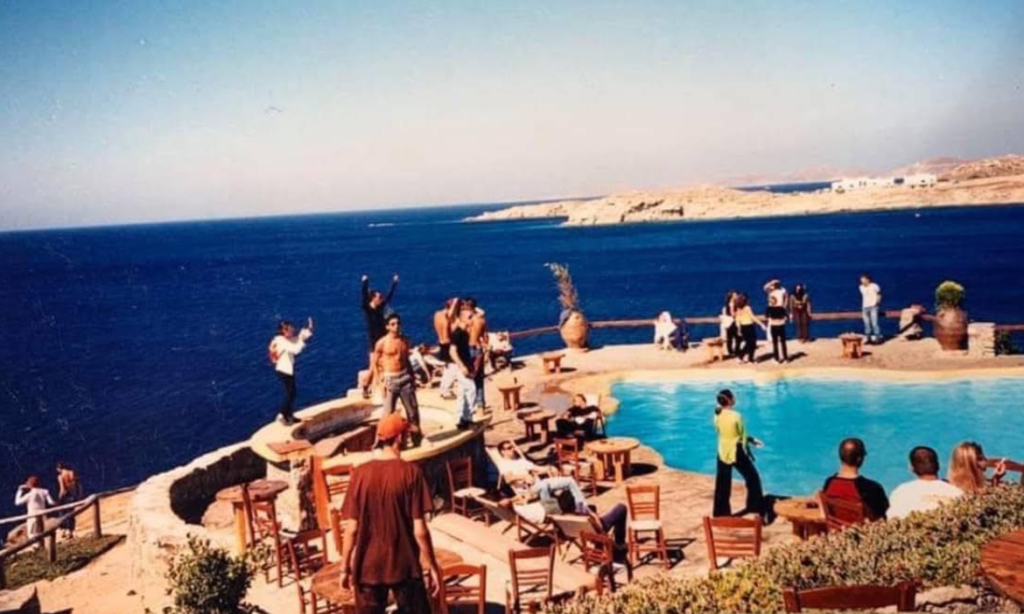
Alexandros Drakos needs little introduction to those familiar with Greece’s electronic music scene. A radio producer, organizer of iconic parties, creator of the magazines Lemon and Freeze, and administrator of the highly active Facebook community “+Soda,” which counts more than 17,500 members, he remains an integral part and living piece of the club culture history of the 1990s.
Reserved, humble, and always exceptionally well-informed, he left his mark on Athens radio through Life FM—the station that revolutionized the airwaves by embracing every genre of electronic music—and later as co-owner and founder of NRG. Having organized unforgettable events at some of the country’s biggest clubs, he now takes us back in time through a deeply moving and nostalgic post.
On the occasion of the Holy Spirit long weekend, Drakos transports us to a different Mykonos and a different Greece. A time when clubbing did not need social media, VIP tables, or influencers to make history. Instead, it thrived on authenticity, a passion for music, friendships formed aboard the express ferries, and the magical sunrise at Cavo Paradiso.
Read his captivating post in full:
“There was a time when the Holy Spirit long weekend was not just another public holiday. It was the official opening of the Greek summer clubbing and party season, especially on the islands. It was the moment when Athens emptied out, the ports filled up, and thousands of young people boarded ferries carrying little more than a backpack, a few euros in their pockets, and a single destination in mind: the Cyclades.
The unofficial opening, of course, came on Easter Sunday, when the summer clubs in Athens and Thessaloniki began operating and Cavo opened its doors with Greek DJs during the years when Greeks could still afford to travel.
Before social media, before Stories and VIP tables, summer began in Piraeus. Those early mornings when groups of friends rushed to catch the Express ferries—Samina, Santorini, Athena, Artemis, Naias, Milos, and later Blue Star and Highspeed—armed with CD wallets, Nokia 3310s, Sony Ericssons, Motorolas, Oakley sunglasses, and the first digital cameras. The first pre-party was already happening on deck.
And if there was one destination that symbolized that era, it was Cavo Paradiso in Mykonos. The legendary club opened in 1993 above Paradise Beach and within just a few years became a pilgrimage site for house and techno fans from across Europe.
Back then, Mykonos had not yet become the ultra-luxurious playground of millionaires and influencers. Yes, there was glamour, but it coexisted with students, workers who had saved an entire month’s salary for the long weekend, ravers from all over Greece, and international clubbers who followed DJ lineups as passionately as football fans follow transfer news.
Student holiday packages were especially popular. I remember those organized by Giorgos Nedos’ Escape Club. Throughout May, students and young people from provincial towns who had moved to the big cities for university would stand in awe of everything they experienced at Super Paradise during the day and later at Cavo during the night.
People would arrive at Cavo after 2 a.m. The truly dedicated arrived after 4. The night reached its peak when the sun began rising over the Aegean and the dancefloor kept moving, unable to tell whether it was still night or already morning. Those legendary sunrise sets became the club’s trademark and one of the reasons for its worldwide reputation.
In the late 1990s and early 2000s, artists who were already at the top of their game—and who later became legends of electronic music—performed there: David Morales, Louie Vega, Frankie Knuckles, Pete Tong, John Digweed, Sasha, and later Sven Väth and Richie Hawtin.
But the Holy Spirit weekend was not just about Mykonos.
It was Ios, with its whitewashed alleyways filled with backpackers and clubs playing everything from metal to rave. It was Paros, with Linardo in Naoussa, Hard Rock—which hosted rave events as early as 1992—Mezzo Mezzo, and Akrovatis in Lefkes, long before the island became a premium destination. It was Naxos, where beach bars played house music until sunrise. It was Crete, with parties in Hersonissos and Malia packed with British and Dutch visitors, and trance events hidden in gorges. It was Halkidiki, operating much like Athens’ famous coastal nightlife strip. It was the legendary Loca in Aigio, a venue that felt like an island itself and could draw as many as 3,000 people to each event.
It was an era when every island had its own scene, its own DJs, and its own tribe of summer travelers.
There was no FOMO because nobody knew what was happening elsewhere. If you were there, you were there. Memories lived on in blurry photographs, ferry tickets forgotten in drawers, and CD compilations from Ministry of Sound, Global Underground, Café del Mar, Discobole, Planetworks, and Digital Underground.
Today the islands may be better organized, the clubs more spectacular, and the DJs more expensive. But something of that innocence has disappeared. The anticipation of the journey, the mystery of the night ahead, the feeling that summer truly began only when the ferry cast off its ropes.
For those who lived through those years, the Holy Spirit long weekend was never just a getaway. It was a rite of passage. An annual rendezvous with the Aegean, the sea, music, and freedom.
It is no coincidence that somewhere between the roar of the ferry engines, the first distant beats echoing through the night, and the sunrise over the dancefloor of Cavo Paradiso, an entire generation of summer memories was born.”
Content Manager: Ambassador Mykonos Promo Kostas Skagias