

Awe Inspiring Church in Greece Honors the Heroes of the 1821 Revolution Alongside the Saints
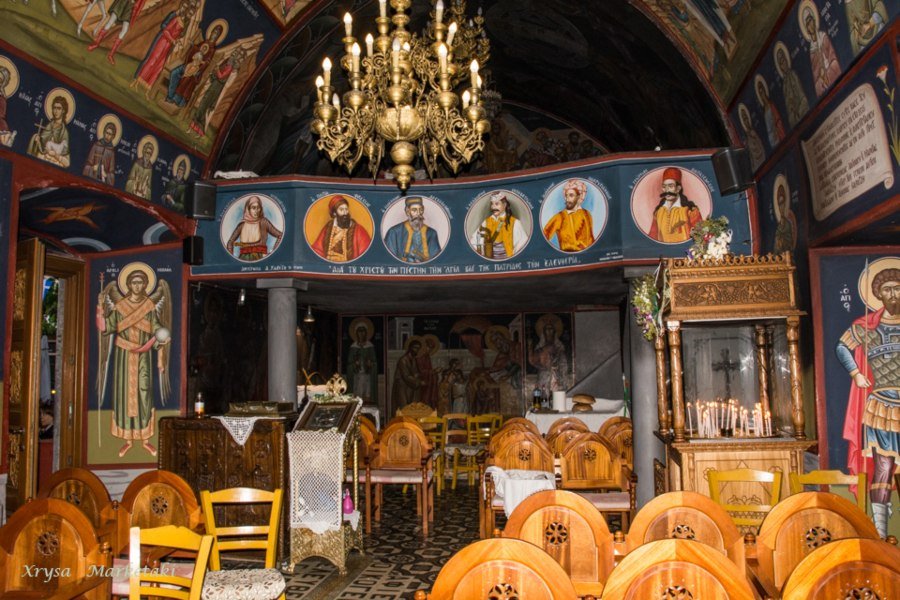
It is the only church in Greece where the heroes of the Greek War of Independence are honored alongside the saints. Among the icons of Saint George, Christ, and the Virgin Mary are depictions of some of Greece’s most celebrated national figures, including Theodoros Kolokotronis, Georgios Karaiskakis, Papaflessas, Ioannis Makriyannis, and Laskarina Bouboulina.
The church stands in the heart of Anogeia, in the village’s central square known as Meidani. It is dedicated to Saint George, and the initiative to include the heroes in its iconography came from Father Andreas Kefalogiannis. Beyond his role as a priest, he believes it is his duty as a patriot to honor those who fought for the freedom that Greeks enjoy today.
Father Andreas explained his decision by saying, “Their place is here. Without them, there would be no Orthodoxy.”
The heroes were added to the church’s iconography in 2005 with financial support from Aristeidis Chairetis. The history of the church itself, however, stretches back much further and is closely connected to the difficult years of Ottoman rule.
It is one of only five churches that the Ottoman authorities permitted to be built in Crete during their long occupation of the island, and it is the largest of the five. According to local tradition, milk rather than water was used to prepare the mortar during its construction. At a time when many Christian churches elsewhere were either destroyed or converted into mosques, the people of Anogeia were able to build a new church dedicated to Saint George, the warrior saint who was martyred during the persecutions ordered by the Roman Emperor Diocletian.
Remarkably, the Church of Saint George was allowed to be built despite a period marked by religious persecution, forced conversions to Islam, and widespread efforts to suppress Christianity in Crete under Ottoman rule.
By including the six heroes of the 1821 Revolution in the church’s rich iconographic decoration, Father Andreas hoped to set an example and inspire younger generations.
His intention was to remind young people that, should the nation ever face such challenges again, the example to follow would be that of the men and women who fought to defend Greece’s faith and homeland, with Orthodoxy playing an inseparable role in their struggle. As Father Andreas has previously emphasized, history records that the success of the Greek Revolution of 1821 was achieved through both divine providence and the determination of the Greek people.
The revolutionary leader and writer Ioannis Makriyannis famously wrote:
“…Those who have sold themselves to foreign interests insult our priests, calling them cowardly and unwilling to fight. Yet our priests stood beside us at every defensive position, in every hardship and every suffering. They were there not only to bless our sacred weapons, but also carrying rifles and swords, fighting like lions.”
Even Ottoman sources acknowledged the involvement of the Orthodox Church in the Greek War of Independence. A Turkish history textbook used in high schools reportedly teaches that, “The Patriarch and the senior clergy of the Greeks led the Greek nation in this revolution together with the monks.”
Within this context, Father Andreas Kefalogiannis honors, through these six revolutionary figures, all those who sacrificed their lives, both within and outside the Church, so that future generations could freely practice the Christian faith and preserve Greece’s cultural and educational heritage.
The Church of Saint George in Anogeia celebrates its feast day twice each year, on April 23 and again on November 3.
Content Manager: Ambassador Mykonos Promo Kostas Skagias